
Market Trends
Coastal Boutique Hotels Market Trends
From Half Moon Bay in the north to San Luis Obispo and points south the greater California Central Coast is one of the world most beautiful and popular travel destinations.
Hotel and B&B market conditions are impacted by national trends, but the special nature of the Central Coast means that property owners and buyers need to be aware of the important local factors that determine property values.
Visit this page often for updated information on market trends.


Coastal Scarcity Enhances Value
Recently the Santa Cruz La Bahia hotel development was shot down by the Coastal Commission after years in the planning and approval process.
Because of the many barriers to entry, existing hotel / B&B properties will continue to be extremely scarce in desirable coastal areas.
Read More
In desirable coastal areas the value of a property is determined by more than the cap rate (the ratio of property price to annual cash flow.) It often said that they are not making any more coastline.
A property owner must consider not only the annual return on invested capital but also the long term opportunity for the underlying real estate asset to appreciate.
In many areas it is almost impossible to build a new hotel. For example in Santa Cruz the Coastal Commission repeatedly torpedoed a proposed new hotel development that would have revitalized a depressed area, and that had the full support of the City Council.
The planning process took 20 years before approval was achieved. Barriers to entry include water restrictions, restrictive zoning, city or county or Coastal Commission opposition, and so on.
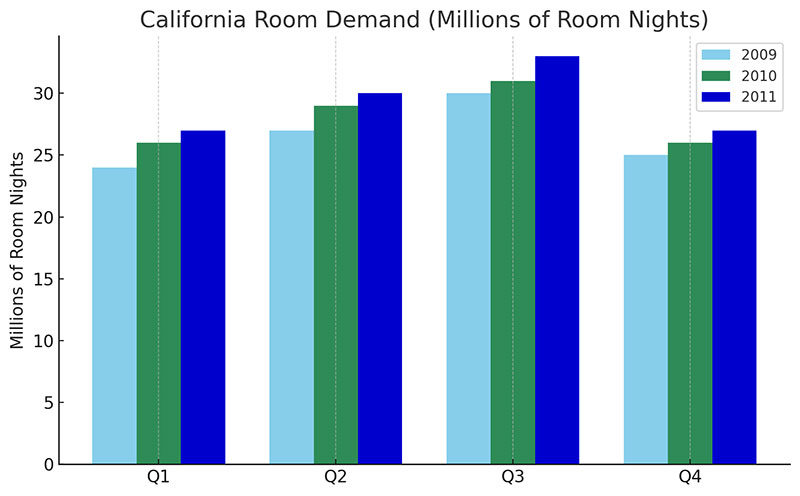
California Room Demand
The past few years have seen strong growth in the number of room-nights sold in our state. California is the number one travel destination in the United States. In 2010, approximately 200 million visitors generated $95.1 billion in spending on goods and services in the state.
Visitor spending directly supported jobs for 873,000 Californians and resulted in $6.1 billion in direct state and local tax revenues.
Room demand has increased in every quarter during 2009-2011, an average annual rate of increase of 5.2%. (Sources: Dean Runyan Associates / Smith Travel Research Reports prepared for the California Travel and Tourism Commission.)
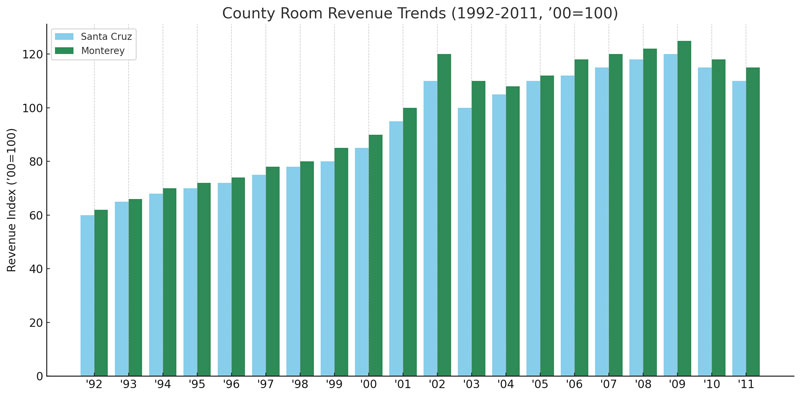
Central Coast Room Revenue Trends
Total room revenue has shown excellent long term growth in the California Central Coast. For example, if we look at Santa Cruz and Monterey Counties we see a dip in the post-2001 period and a dip in the post-2008 period. In 2010-2011, both counties show resumed growth. And if we look at two decades of data we see that despite ups and downs, there is clear long term upward momentum. Similar trends are evident elsewhere in the Central Coast. (Sources: Dean Runyan Associates / Smith Travel Research Reports prepared for the California Travel and Tourism Commission.)